Minimum Viable Product (MVP)

Blog Thirteen: 4/15/2019

A Minimum Viable Product (MVP) is the “Smallest product that can be built that allows assumptions to be tested by giving it to a user group and seeing what happens” (Preece, Rogers & Sharp, 2015, p. 436). This is a type of prototype that is used in Lean UX because it allows designers to quickly turn out a product with the minimum features that the designers want feedback on.

Reflection on the Topic

  1. When I think of a Minimum Viable Product, I envision a character from a movie working away in their home laboratory or workshop to create a hastily built product that represents an invention they may have. From this, the character will have a prototype to show their family and friends their great idea.  
  2. On discussing the significance of MVP’s, Forbes describes them as tools to avoid failures and large capital losses, gain valuable insight on what works and what doesn’t work, and to test the demand for your product before releasing a full-fledged product among many other benefits (Forbes 2018).
  3. Below is an image taken from the TV show F is for Family where the mother, Sue Murphy, creates an MVP using various household items, including the drum of an old washing machine to create the Salad Spinner, one of the many products she is desperately trying to pitch to investors.
The Salad Tosser MVP
The Salad Spinner, Finished Product

My Thought

“I especially enjoyed reading this chapter of our Interaction Design textbook because it taught me that there are various methods of creating prototypes that are acceptable when trying to create or modify a product. This was enlightening because I, like so many people, get ideas and don’t know what the next step should be to further that idea along the path of creating a tangible product. It was also helpful for me to read that “Conducting UX activities within an agile framework requires a flexible point of view that focuses more on the product as the deliverable than the design artifacts as deliverables” (434) which I interpreted as saying that its more important to get the job done than to make all the steps toward finishing the task perfect along the way” (Ingrid Bright 2019).

Reference List

  1. Preece, Rogers & Sharp, (2015). Interaction and Design: Beyond human-computer interaction. West Sussex, United Kingdom: John Wiley & Sons, Ltd.
  2. Perkins, D. (2018, July 20). Bonding over mutual failure is sometimes all the Murphy’s have on F Is for Family. Retrieved April 15, 2019, from https://tv.avclub.com/bonding-over-mutual-failure-is-sometimes-all-the-murphy-1798191929
  3. Quora. (2018, February 27). What Is A Minimum Viable Product, And Why Do Companies Need Them? Retrieved April 15, 2019, from https://www.forbes.com/sites/quora/2018/02/27/what-is-a-minimum-viable-product-and-why-do-companies-need-them/#1186709c382c

Scenario

Blog 11: 3/31/2019

A scenario can be defined as “An informal narrative description” (Preece, Rogers & Sharp, 2015, p.371). These are frequently used when describing events, books, or movies, with the narrator explaining the content to give the listener an understanding of the topic.

Reflection on the Topic

  1. I frequently use scenarios to describe my day to my Husband. He will do the same thing in return, so we are putting the timeline of events that happened to us throughout the day in the context of a short story.
  2. According to Merriam-Webster’s definition of a scenario, it is “A sequence of events especially when imagined” (Merriam-Webster).
  3. The image below represents what first comes to my mind when I think of the word scenario, the comparison of the process and outcome of different events. This is a visual representation of a student considering the different scenarios that would occur depending on the results of her assessment.

My Thought

“From our reading, I was able to get a better understanding of the word “scenario”. I had the vague idea that a scenario described the discussion of an event to someone but did not know that this is considered a useful form of explanation because we are able to easily interpret concepts and events through story telling” (Ingrid Bright, 2019).

Reference List

1. Create a Pre-Assessment Scenario for E-Learning. (2015, June 03). Retrieved March 31, 2019, from https://ilite.wordpress.com/2015/06/03/create-a-pre-assessment-scenario-for-e-learning/

2. Scenario. (n.d.). Retrieved March 31, 2019, from https://www.merriam-webster.com/dictionary/scenario

3. Sharp, Preece, & Rogers. (2019). INTERACTION DESIGN: Beyond human-computer interaction (4th ed.). Place of publication not identified: JOHN WILEY & Sons.

Prototype

Blog Ten: 3/18/2019

Creating a Prototype “Involves producing a limited version of the product with the purpose of answering specific questions about the design’s feasibility or appropriateness” (Preece, Rogers & Sharp, 2015, p. 340). The practice of using a prototype has proven to be very useful in the process of Interaction Design because it gives the users a better understanding of how the product works.

Reflection on the Topic

  1. The first thing that comes to my mind when I think of the word prototype are the car commercials that I have watched where sketches or a clay concept car are shown to highlight the design process that is involved in the development of a new car
  2. An additional definition of the term from Techopedia states that “A prototype has many benefits, such as the developer and the implementer getting valuable feedback from the user even before the actual project is started” (Techopedia).
  3.  Below is an image that reflects what comes to my mind when I think of the word prototype. These two designers are working on a concept model of a Volkswagen Bug using clay as their medium.

My Thought

 “The practice of creating a prototype for users should be a standard in interaction design, especially if the proposed technology or product does not bare resemblance to any other existing technology or product. I believe this can help to keep a project going in the right direction as some design aspects may not be feasible when translated to a tangible product.” (Ingrid Bright, 2019).

References

  1. Preece, Rogers & Sharp, (2015). Interaction and Design: Beyond human-computer interaction. West Sussex, United Kingdom: John Wiley & Sons, Ltd.
  2. Car, Clay Modeling Dough, Staedtler, Motor Vehicle PNG image with transparent background. (n.d.). Retrieved March 18, 2019, from https://www.kisspng.com/png-car-clay-modeling-dough-staedtler-industrial-plast-6214739/preview.html
  3. What is Prototype? – Definition from Techopedia. (n.d.). Retrieved March 18, 2019, from https://www.techopedia.com/definition/678/prototype

Grounded Theory

Blog Eight: 3/9/2019

Grounded Theory is “An approach to qualitative data analysis that aims to develop theory from the systematic analysis and interpretation of empirical data, i.e. the theory derived is grounded in the data” (Preece, Rogers & Sharp, 2015, p.303). This approach differs from others because it involves developing a theory on data that has already been collected, rather than establishing a theory and then collecting evidence to support that theory.

Reflection on the Topic

  1. An example for a concept to be studied using grounded theory would be if a researcher collected data to study the effect exercise has on the quality of one’s sleep. The researcher would review data on participants with varying levels of regular exercise, from daily to not at all, and then create categories based off the patterns seen in this data. After this has been done, the researcher can begin to develop theories and then do further research to support these theories.
  2. From an article in the International Encyclopedia of the Social & Behavioral Sciences, K. Charmaz defines grounded theory as being “Introduced as an inductive, comparative methodology that provides systematic guidelines for gathering, synthesizing, analyzing, and conceptualizing qualitative data for the purpose of theory construction” (K. Charmaz, Science Direct (2001).
  3. Below is a visual representation of grounded theory compared to traditional theories.

My Thought

“It was interesting to learn about the different theoretical frameworks that can be used to organize qualitative data. I was not familiar with the concept of grounded theory because I was under the impression that theories were developed first and then data collection came second, however it is easy to see that there are many ways to develop promising theories.” (Ingrid Bright, 2019).

Reference List

  1. Preece, Rogers & Sharp, (2015). Interaction and Design: Beyond human-computer interaction. West Sussex, United Kingdom: John Wiley & Sons, Ltd.
  2. K. C. (2001). Grounded Theory. Retrieved March 9, 2019, from https://www.sciencedirect.com/topics/neuroscience/grounded-theory
  3. Mediani, H. S. (2017, November 6). An Introduction to Classical Grounded Theory. Retrieved March 9, 2019, from https://symbiosisonlinepublishing.com/nursing-healthcare/nursing-health-care35.php

Triangulation

Blog 7: 3/4/2019

Triangulation is the “Investigation of a phenomenon from (at least) two different perspectives (Preece, Rogers & Sharp, 2015, p.230). Frequently, different methods of data collection are used making true triangulation difficult to accomplish. For example, the same subject could have been put through different types of tests where one is concerned with sound and the other is concerned with liquids. The results of these separate tests would be difficult to relate to one another.

Reflection on the Topic

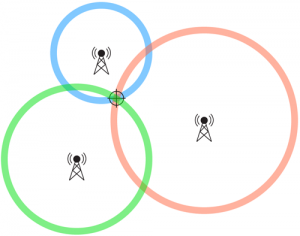
  1. An example of triangulation that makes the term easy for me to understand is how a GPS will triangulate signals from three different satellites at any given time in an attempt to pinpoint a geographical location.
  2. Prashant Kulkarni, responding to an inquiry on the Research Gate website, describes triangulation in a research context as “…Using more than one method to collect data on the same topic. This is a way of assuring the validity of research through the use of a variety of methods to collect data on the same topic, which involves different types of samples as well as methods of data collection” (Kulkarni, Research Gate).
  3. Below is a visualization of the method of triangulation that is used in tracking the location of a cellphone, much like the method of triangulation that is used in GPS.

My Thought

“I’m aware of the importance of double-checking information and now know that the correct term for this practice is Triangulation. It was interesting to learn that there are four types of triangulation (of theories and data, as well as investigator and methodological) but that the different results that are yielded from different studies can sometimes make triangulation impossible.” (Ingrid Bright, 2019)

Reference List

  1. Preece, Rogers & Sharp, (2015). Interaction and Design: Beyond human-computer interaction. West Sussex, United Kingdom: John Wiley & Sons, Ltd.
  2. Kulkarni, Prashant (2014). What is triangulation of data in qualitative research? Retrieved from https://www.researchgate.net/post/What_is_triangulation_of_data_in_qualitative_research_Is_it_a_method_of_validating_the_information_collected_through_various_methods/
  3. Cell Phone Triangulation (2019). http://4n6.com/cell-phone-triangulation/

Robots

Blog Six: 2/24/2019

Robots exist as “Part of manufacturing assembly lines, as remote investigators of hazardous locations, and as search and rescue helpers in disasters or far away places…as well as domestic devices that help with tasks like cleaning” (Preece, Rogers & Sharp, 2015, p.215). The concept of robots with anthropomorphic qualities remains a controversial issue. With this considered, many researchers are focused on building robots with more zoomorphic qualities that simulate a pet-like interaction with the user.

Reflection on the Topic

  1. The term robot is hard to define but does require the possession of certain characteristics in order to distinguish it from an ordinary device or machine.
  2. A definition from the Galileo website’s page on Robotics states, “Well it is a system that contains sensors, control systems, manipulators, power supplies and software all working together to perform a task” (Galileo). The definition goes on to say that building a robot requires the combination of many disciplines including engineering, mathematics, and even biology.
  3.  Below is an image of the Roomba robotic vacuum that depicts its ability to sense the floorplans for different rooms of a house.

My Thought

“I chose to discuss the term “robotics” from chapter 6 of our text because I wanted to better understand its definition. I was surprised to learn the different characteristics a system must have to qualify as a robot, namely those that involve sensing and power supplies. A robot must be able to sense the environment it is in, maybe with light sensors or sonar sensors, and it also must be able to “power itself” through the use of solar, battery, or electrical power” (Ingrid Bright, 2019).

Reference List

  1. Preece, Rogers & Sharp, (2015). Interaction and Design: Beyond human-computer interaction. West Sussex, United Kingdom: John Wiley & Sons, Ltd.
  2. Robotics. (n.d.). Retrieved February 24, 2019, from https://www.galileo.org/robotics/intro.html
  3. Roberts, J., & Roberts, J. (2018, September 24). iRobot Roomba i7 review – a robot vacuum with surprising features. Retrieved February 24, 2019, from https://www.vacuumsguide.com/irobot-roomba-i7-plus/

Affective Computing

Blog Five: 2/17/2019

Affective Computing is an approach that “Develops computer-based systems that try to recognize and express emotions in the same way humans do” (Preece, Rogers & Sharp, 2015, p. 143). This has resulted in the creation of artificial intelligence that can communicate and interact with humans in a manner that mirrors the behavior of humans.

Reflection on the Topic

  1. The idea of affective computing involves the integration of many disciplines that attempt to turn abstract ideas from science fiction into reality.
  2. A website devoted to the division of Affective Computing at MIT describes affective computing as “…research (that) combines engineering and computer science with psychology, cognitive science, neuroscience, sociology, education, psychophysiology, value-centered design, ethics, and more” (Media MIT).
  3. Although only a theoretical representation of AI, this system is deep in thought. To make this possible, concepts from affective computing would have to be applied to the system during its assembly.

My Thought

“It was exciting to learn that there is a legitimate effort being made in the development of Artificial Intelligence. While it is somewhat unnerving because of the ways AI has been depicted in books and movies, the progress in affective computing shows what can be achieved with the collaborative efforts of today’s researchers in science and technology” (Ingrid Bright, 2019).

Reference List

  1. Preece, Rogers & Sharp, (2015). Interaction and Design: Beyond human-computer interaction. West Sussex, United Kingdom: John Wiley & Sons, Ltd.
  2. Affective Computing. (n.d.). Retrieved February 17, 2019, from https://affect.media.mit.edu/
  3. Our Trust Deficit with Artificial Intelligence [Digital image]. (n.d.). Retrieved February 17, 2019, from https://www.google.com/url?sa=i&source=imgres&cd=&cad=rja&uact=8&ved=2ahUKEwjzpZvVgcTgAhXnCTQIHVtsAjcQjRx6BAgBEAU&url=https://moderndiplomacy.eu/2018/10/03/our-trust-deficit-with-artifical-intelligence-has-only-just-started/&psig=AOvVaw3fCAQAQf_wLAeZ-KVPY_V8&ust=1550535677511343

Adjacency Pairs

Blog Four: 2/10/2019

Adjacency Pairs are “Utterances (that) are assumed to come in pairs in which the first part sets up an expectation of what is to come next and directs the way in which what does come next is heard” (Preece, Rogers & Sharp, 2015, p. 103). These patterns are used when establishing a conversation between two or more people and they help guide the start and stop of the dialog.

Reflection on the Topic

  1. Some of the adjacency pairs that I use most often begin with “how was your day?” and “do you know what time it is?”. These make it very easy for me to begin or navigate a conversation, even if I am not very familiar with the person I am talking to.
  2. Richard Nordquist, a Professor of English and Rhetoric, discusses the use of adjacency pairs in conversational analysis by describing them as being “…a two-part exchange in which the second utterance is functionally dependent on the first, as exhibited in conventional greetings, invitations, and requests” (Richard Nordquist 2018).
  3. Below is an example of three sets of people having conversations with one another. The content of their dialog’s more likely than not incorporated the use of adjacency pairs to begin, continue, or end their conversations.

My Thought

“From this module on social interaction, I learned that the term “adjacency pairs” is a formal name for a conversational technique I use every day. Now that I know that certain patterns can be followed when creating a conversation, I can try to deploy them to better navigate my interactions with people.” (Ingrid Bright, 2019).

Reference List

  1. Preece, Rogers & Sharp, (2015). Interaction and Design: Beyond human-computer interaction. West Sussex, United Kingdom: John Wiley & Sons, Ltd.
  2. Nordquist, R., Ph.D. (2018, July 12). Adjacency Pair (Conversation Analysis). Retrieved February 10, 2019, from https://www.thoughtco.com/richard-nordquist-1688331
  3. Conversation Partners [Digital image]. (2018, Fall). Retrieved February 10, 2019, from http://www.arch.tamu.edu/diversity/college/events/conversation-partners/

Externalizing to Reduce Memory Load

Blog 3: 2/4/2019

Externalizing to reduce memory load is a cognitive activity that involves “Transforming knowledge into external representations to reduce memory load” (Preece, Rogers & Sharp, 2015, p. 93). This is a representation of external cognition that involves outwardly expressing one’s internal thoughts in a way that relieves one’s mind to focus on other things.

Reflection on Topic

  1. Before reading this chapter on cognitive aspects, I did not have a name for my habit of writing out the things that were running through my mind on paper for later reference. I have been doing this practice of externalization for years now with the specific goal of freeing my mind of important tasks and things to remember without forgetting them completely. Now I know that this is what is referred to as “externalizing to reduce memory load” (93).
  2. This representation of external cognition is very helpful because “Memory load reduces users’ capacity to perform the main task” (University of Texas School of Biomedical Informatics). Whether one is externalizing thoughts to save for later or to compile notes on the task at hand, it can be very beneficial to declutter one’s brain to stay focused.
  3. Below is an example of lecture notes that a student has created to externalize their memory load. With these notes, they were able to retain information from the lecture while keeping their mind clear to process new information to add to their notes as the lecture continued.

My Thought

“The practice of notetaking has always made a significant impact on the way that I remember information. Whether they are lecture notes or lists that I have created for myself as reminders of what I need to accomplish, I have learned that this an important cognitive aspect that is a form of externalization to reduce memory load. Without this practice I know for certain that much of what I read and think would remain passive and get displaced by new thoughts, even if they are of less importance.” (Ingrid Bright, 2019)

Reference List

  1. Preece, Rogers & Sharp, (2015). Interaction and Design: Beyond human-computer interaction. West Sussex, United Kingdom: John Wiley & Sons, Ltd.
  2. Minimize Memory Load – Design Principles – General Design Principles & Guidelines – Designing for Usability – EHR Usability – NCCD – The University of Texas Health Science Center at Houston (UTHealth) School of Biomedical Informatics. (n.d.). Retrieved February 4, 2019, from https://sbmi.uth.edu/nccd/ehrusability/design/guidelines/Principles/memory.htm
  3. Notes on Effective Note Taking [Digital image]. (n.d.). Retrieved February 4, 2019, from https://www.vcestudyguides.com/blog/notes-on-effective-note-taking

Interface Metaphors

Blog Two: 1/27/2019

Interface Metaphors are frequently used to describe an abstract technological concept in a way that creates a familiar understanding of its purpose and function among its new user “More specifically, an interface metaphor is one that is instantiated in some way as part of the user interface: for example, the desktop metaphor” (Preece, Rogers & Sharp, 2015, p. 44).

Reflection

1. The idea of using metaphors when describing a new graphical interface can be helpful when introducing an abstract concept. With the anxiety that can come from using new technology, creating a familiar concept for users to refer to can help the user feel more comfortable as they adjust to the interface.
2. When Douglas Engelbart of PARC discussed “The first GUI developed by researchers at Xerox Palo Alto Research Center (PARC) in the ‘70s. This research opened a whole new era of computer graphic innovations” (Operating System Interface Design Between 1981-2009). Researchers at PARC understood that in releasing this new interface, it was pertinent to make its purpose very easy to comprehend and used the metaphor of an office desktop as something the user was familiar with to bridge the gap of the unknown desktop environment. Components of this metaphor included references to files, folders, and even a recycling bin that all had similar functions within the interface that they would have in real life.
3. The desktop metaphor creates an excellent visual of what the user sees when they open various applications on their computer. Some of the cornerstones of a modern desktop home screen include a clock, information on the weather, email icons, and a file folder icon that the user can open to access all of the images and documents on their computer.

My Thought

“On reading Chapter 2: Understanding and Conceptualizing Interaction, I found that the use of interface metaphors serve as meaningful resources to users when addressing a new technology. Often it is hard to envision an abstract concept until it is put into information that brings meaning and understanding to the user. Similar to when someone describes something using the phrase “In other words…”, this can be essential in bringing clarity to a user especially when they need more of a visual for comprehension.” (Ingrid Bright, 2019)

Reference List

  1. Preece, Rogers & Sharp, (2015). Interaction and Design: Beyond human-computer interaction. West Sussex, United Kingdom: John Wiley & Sons, Ltd.
  2. Group, N. N. (n.d.). The Anti-Mac User Interface [Cartoon]. In Nielsen Norman Group.
  3. W. S. (2018, February 07). Operating System Interface Design Between 1981-2009. Retrieved January 27, 2019, from https://www.webdesignerdepot.com/2009/03/operating-system-interface-design-between-1981-2009/